Small Business Marketing Plan Template (Free + Example)
MyMarketPlan Team · October 15, 2026

Most small businesses market the same way: a post when things are slow, a promotion when a competitor runs one, an ad because someone called offering a deal. It feels busy, but it rarely adds up to steady growth.
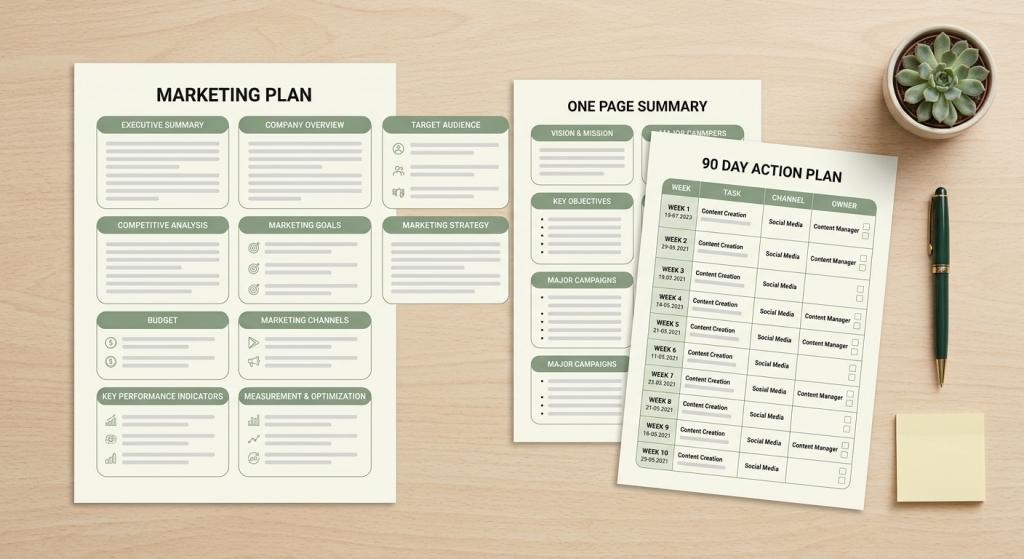
A small business marketing plan template fixes that by giving you a simple structure: who you're trying to reach, what you'll say, where you'll say it, what it will cost, and how you'll know it worked. The free template below is built for owners without a marketing team. You can fill it in over one afternoon and run it for the next 90 days.
Get the free one-page template — fill it in below, plus a full 10-section guide, a worked example and a 90-day action plan.
Jump to the one-page template ↓ · Jump to the completed example ↓
What is a small business marketing plan?
A small business marketing plan is a short, practical document that sets your marketing goals, defines your ideal customer, chooses the channels you'll use to reach them, and assigns a budget, timeline and success measures to each activity. It turns "we should do more marketing" into a list of specific tasks.
The U.S. Small Business Administration recommends every small business keep one, since it turns marketing from a reactive expense into a planned, budgeted part of running the business. It's not the same as a business plan. A business plan covers everything: operations, finances, legal structure, hiring. A marketing plan zooms in on one job — how you'll attract, convert and keep customers. If you already have a business plan, your marketing plan is the detailed version of its marketing section.
What's included in the template
The template has 10 sections. Each one includes a prompt question and a grey example line so you're never staring at a blank box.
- Executive summary
- Business and marketing goals
- Target customer and persona
- Competitors and SWOT
- Value proposition and key message
- Offer, pricing and positioning
- Marketing channels
- Marketing budget
- 90-day action plan
- KPIs and review schedule
Prefer not to fill this in by hand? Get a marketing plan for small business, free — MyMarketPlan generates a full, personalized strategy in minutes: competitive analysis, SWOT, target market and a budgeted 30/60/90 day action plan, built from your own business details instead of a blank template.
How to fill out your marketing plan, step by step
Work through the sections in order, except the executive summary, which you'll write last. Every step below includes an example from Maple Street Bakery, a fictional neighborhood bakery we use throughout this guide, plus the mistake owners make most often.
1. Executive summary (write it last)
This is a three-to-five sentence snapshot of the whole plan: who you serve, your main goal, your top channels and your budget. Writing it last means it summarizes decisions you've actually made rather than hopes.
Example: "Over the next 90 days, Maple Street Bakery will grow weekday morning sales by 15% by reaching nearby office workers through our Google Business Profile, an email list and a coffee-shop partnership, on a budget of $600 a month."
Common mistake: Writing a mission statement instead of a summary. Keep it to numbers and decisions.
2. Business goals and marketing goals
Start with one or two business goals (revenue, customers, bookings), then set marketing goals that drive them. Make each one SMART: specific, measurable, achievable, relevant and time-bound. Set a 90-day goal you'll act on now and a 12-month goal for direction.
Example: Business goal: raise weekday revenue 15% by January 31. Marketing goal: collect 400 email subscribers and get 60 new Google reviews in 90 days.
Common mistake: Goals like "grow our social media." Followers aren't revenue. Tie every goal to sales, leads or repeat customers.
3. Target customer and persona
Describe the one type of customer who is most valuable to you right now. Include who they are, where they live or work, what problem you solve for them, where they spend time (online and offline) and what makes them choose one business over another. One primary persona is enough for a small business; add a second only if it truly behaves differently.
Example: "Office Olivia, 28–45, works within six blocks, buys breakfast on the way in, decides in under a minute, checks Google Maps for what's open and close, values speed and a good coffee."
Common mistake: "Everyone is our customer." If you target everyone, your message fits no one.
4. Competitors and SWOT
List your three closest competitors — the places your customer would go if you didn't exist — and note what they do well and where they fall short. Then fill in a four-box SWOT: your strengths, weaknesses, opportunities and threats. Keep each box to three bullets.
Example: Strength: everything baked on site daily. Weakness: no online ordering. Opportunity: new office building opening next door. Threat: chain café two blocks away running loyalty discounts.
Common mistake: Spending days on analysis. The SWOT exists to inform your channels and message, not to be perfect.
5. Value proposition and key message
Your value proposition answers one question: why should your target customer pick you over the alternatives? Write it as one sentence, then turn it into a short key message you'll repeat across every channel.
Example: Value proposition: "Fresh-baked breakfast and real coffee, ready in under three minutes, steps from your office." Key message: "Baked this morning. Ready in three minutes."
Common mistake: Leaning on "quality" and "great service." Every competitor says that. Use something specific and provable.
6. Offer, pricing and positioning
This is the "4 Ps" (product, price, place, promotion), kept brief. Note your core products or services, how your pricing compares with competitors, where and how customers buy, and any offer you'll use to bring new people in.
Example: Mid-priced versus the chain café; pre-order via text for pickup; launch offer of a free coffee with any pastry for new email subscribers.
Common mistake: Discounting by default. An offer should attract the right customer, not train everyone to wait for a sale.
7. Marketing channels
Pick two or three channels you can run well, based on where your persona actually is. For most local and service businesses, the strongest low-cost options are:
- Google Business Profile and local SEO — so you show up in Maps and "near me" searches.
- Email or SMS — the channel you own, best for repeat customers.
- Referrals and reviews — word of mouth you can encourage on purpose.
- Local partnerships — cross-promotion with businesses that share your customers.
- Social media — one platform your customers use, not all of them.
- Paid ads — useful once the basics are working and you know your numbers.
Example: Google Business Profile (weekly photos and posts), email list (signup at the counter, one email a week), partnership with the gym across the street.
Common mistake: Being on six channels badly. Three done consistently beat six done occasionally.
8. Marketing budget
List each channel with its monthly cost in money and in hours, and how many leads or customers you expect from it. Budgets vary widely by industry and stage, so many owners start with a fixed monthly amount they can sustain and adjust after 90 days based on results. If your budget is $0, your plan still works: lean on your Google Business Profile, email, referrals and partnerships, which cost mostly time.
| Channel | Monthly cost | Hours / month | Expected result |
|---|---|---|---|
| Google Business Profile | $0 | 4 | 20 new reviews |
| Email platform | $30 | 6 | 130 new subscribers |
| Gym partnership (printed cards, samples) | $170 | 3 | 80 first-time visits |
| Local social ads (month 2 onward) | $400 | 2 | 60 first-time visits |
| Total | $600 | 15 |
Common mistake: Forgetting your own time. If a channel takes 20 hours a month, it isn't free.
9. 90-day action plan
Turn your channels into weekly tasks, each with an owner and a due date. Ninety days is long enough to see results and short enough to stay focused. Front-load setup tasks in weeks 1–2, then settle into a weekly rhythm.
| Week | Task | Channel | Owner |
|---|---|---|---|
| 1 | Update Google profile hours, photos and menu | Owner | |
| 1 | Set up email tool and counter signup card | Owner | |
| 2 | Agree partnership terms with gym; print cards | Partnership | Manager |
| 2 | Start asking every regular for a review | All staff | |
| 3–4 | Send first two weekly emails; post weekly Google update | Email, Google | Owner |
Common mistake: Tasks without owners. "We'll post more" never happens; "Sam posts Mondays at 9" does.
10. KPIs and review schedule
Choose three to five numbers that show whether the plan is working, and decide when you'll check them. Useful KPIs for small businesses include:
- New leads or first-time customers per month
- Conversion rate — the share of leads who buy
- Customer acquisition cost (CAC) — marketing spend divided by new customers
- Repeat customer rate
- Revenue from the target product, service or time slot
Example: Check weekday sales and new subscribers every Monday; full plan review on the last Friday of each month.
Common mistake: Tracking likes and impressions instead of customers and revenue.
Small business marketing plan example
Here's the completed one-page plan for Maple Street Bakery. It's an illustrative example, not a real business, but every number in it is consistent so you can see how the sections connect.
| Summary | Grow weekday morning sales 15% in 90 days by reaching nearby office workers through Google, email and a gym partnership, on $600/month. |
|---|---|
| Goals | +15% weekday revenue by Jan 31; 400 email subscribers; 60 new Google reviews. |
| Target customer | Office workers within six blocks, 28–45, buying breakfast on the way in, choosing by speed and proximity. |
| Competitors | Chain café (cheap, loyalty app, mass-produced); food truck (fast, limited menu); deli (slow at peak). |
| SWOT | S: baked daily on site. W: no online ordering. O: new office building next door. T: chain café loyalty discounts. |
| Key message | "Baked this morning. Ready in three minutes." |
| Offer | Free coffee with any pastry for new email subscribers; text-ahead pickup. |
| Channels | Google Business Profile, weekly email, gym partnership; local social ads from month 2. |
| Budget | $600/month and about 15 staff hours. |
| KPIs | Weekday revenue, new subscribers, new reviews, first-time visits, CAC. |
| Review | Weekly numbers check on Mondays; monthly plan review on the last Friday. |
One-page marketing plan version
If the full template feels like too much, start here. Copy this table into a doc or spreadsheet and fill in the right-hand column — that's a complete one-page plan.
| Summary (write last) | |
|---|---|
| 90-day goal | |
| 12-month goal | |
| Target customer | |
| Top 3 competitors | |
| Key message | |
| Channel 1 | |
| Channel 2 | |
| Channel 3 | |
| Monthly budget ($ and hours) | |
| KPIs to review | |
| Review schedule |
Many owners find a single page they review monthly is more useful than a long document they never reopen. Expand into the full 10-section version above whenever a section needs more detail.
Tips to make the plan stick
- Block 30 minutes a month for review. Put it in your calendar now. Compare your KPIs with your goals and decide what to keep, change or drop.
- Track in one simple place. A basic spreadsheet with your weekly numbers is enough — you don't need special software to start.
- Give each channel 90 days. Most channels need time to show results. After 90 days, cut what isn't working and move that time and money to what is.
- Ask customers how they found you. It's free, fast and often more accurate than analytics for a local business.
- Keep the plan visible. Print the one-page version and pin it where you and your team will see it.
Frequently asked questions
What should a small business marketing plan include?
At minimum: SMART goals, a defined target customer, your value proposition, two or three chosen channels, a monthly budget, a 90-day action plan with owners and dates, and a few KPIs you'll review regularly. A competitor review and SWOT help you choose the right message and channels.
How long should a small business marketing plan be?
As short as it can be while still being specific. A one-page plan works for many small businesses. A fuller version usually runs three to ten pages. Length matters less than whether every goal has tasks, owners, dates and a way to measure results.
How much should a small business spend on marketing?
There's no single right number; it depends on your industry, margins, growth goals and stage. Many owners start with a fixed monthly amount they can sustain for 90 days, track the cost of acquiring each customer, then increase spend on the channels that bring customers profitably.
What is the difference between a marketing plan and a business plan?
A business plan covers the whole company: operations, finances, structure, staffing and marketing. A marketing plan focuses only on how you'll attract, convert and keep customers, with specific goals, channels, budget and tasks. It's the detailed, working version of a business plan's marketing section.
How often should I update my marketing plan?
Check your key numbers weekly or monthly, do a full review every 90 days, and rewrite the plan once a year. Update it sooner if something big changes, such as a new competitor, a new product or a shift in your budget.
Can I make a marketing plan with no budget?
Yes. A $0 plan relies on channels that cost time rather than money: a complete Google Business Profile, asking for reviews, an email list, referral requests, local partnerships and one social platform. The template includes a column for hours so you can plan your time like a budget.
Start your plan today
You don't need a marketing team to market with purpose. Fill in the one-page template above one section at a time, and you'll have a 90-day plan you can start on Monday — or skip the manual work and generate a full plan free at MyMarketPlan in minutes.